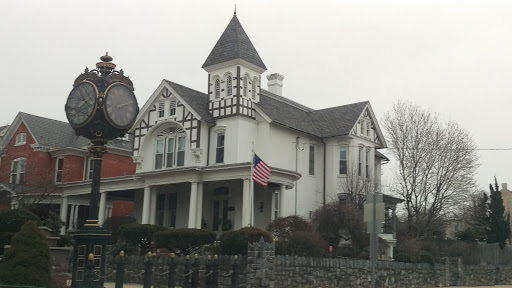
COLUMBIA, Pa. — After a string of crashes at Fifth and Chestnut streets, a resident who lives at the corner asked Borough Council on Thursday to make the intersection safer, and council heard that a traffic light there could cost more than $100,000.
The resident said there have been a couple of crashes at the intersection in the last few months. Drivers pulling out from the stop sign on Fifth Street told her they didn’t realize traffic on Chestnut Street wasn’t stopping. “This intersection is so confusing,” one driver told her.
She wrote to PennDOT. The state replied that even though Chestnut Street is state Route 462, it is the borough’s responsibility to make sure Fifth Street meets the state road safely, and told her to bring her concerns to the borough.
She also asked that next Halloween, a police officer or crossing guard be posted at the corner, where she said excited children in dark costumes dart across in the dark.
A light or a one-way?
A council member said a traffic consultant recently toured the intersection and other problem spots with borough staff, and a report with recommendations is coming soon.
“One of the suggestions is put a light there,” he said. “But the truth is it’s going to cost over $100,000, but it may be the thing that we have to do. That’s a very dangerous intersection.”
Any change on a state road has to be planned and approved by PennDOT first, he added.
Another resident suggested a cheaper fix: block North Fifth Street at Chestnut so drivers can’t go straight across, making that stretch one-way. “It’s got to be a whole lot cheaper than $100,000 for a freaking light,” the resident said.
A council member said drivers ignored a similar setup there before and went around it. Council will review the consultant’s report before deciding.
Ambulance response clarified
Also under public safety, a council member said Penn State Health Life Lion EMS clarified its policy on holding calls. A pending call is held for 15 minutes, then the next available ambulance is assigned. An extra 15-minute hold happens only in rare, lower-priority cases and must be approved by an EMS supervisor. It is not automatic.