By Jesse Sweigart, The Columbia Chronicle
COLUMBIA, Pa. — The settlement agreement that ended Paula Diffenderfer’s time as Columbia Borough’s codes manager runs six pages. The Chronicle has now read all of it against the Pennsylvania laws that govern how a borough makes a deal like this one, and it leaves questions council has not answered in public.
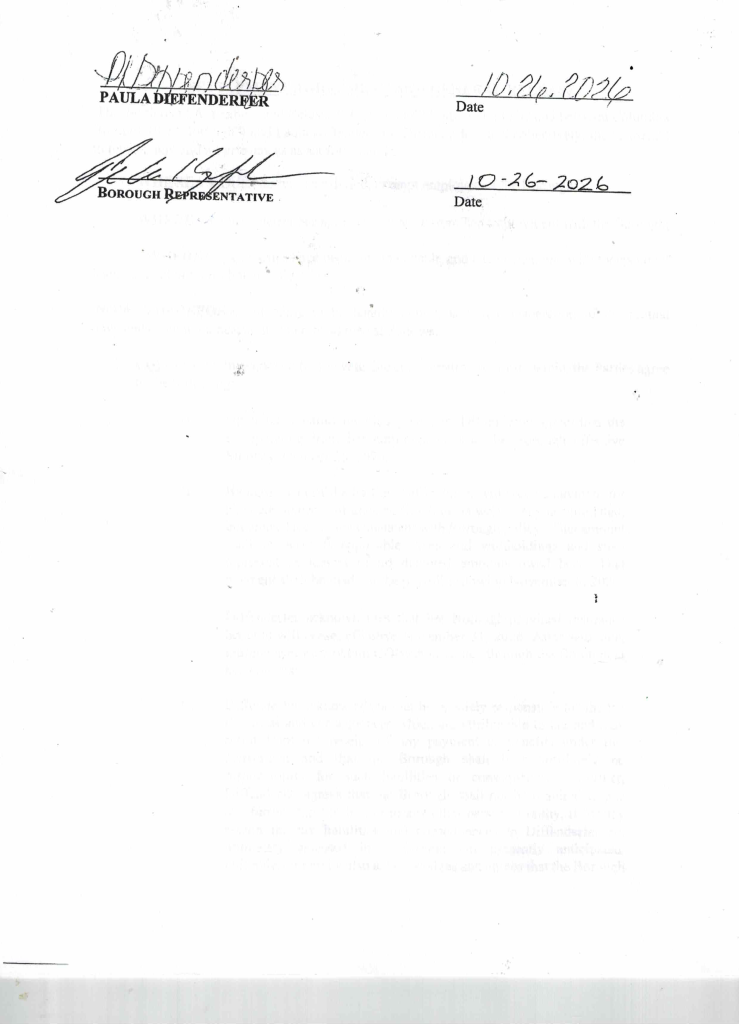
Three things stand out. The agreement was signed for the borough 10 days before council voted. Its own text says it does not take effect until after “any formal approval as required by law.” And much of its wording appears to come from an agreement written for a union or police employee, which Diffenderfer was not.
No court or state agency has found that anyone broke the law here. The Chronicle is not a law firm and this is not a legal opinion. What follows is what the document says, what the statutes say, and what council members have said, so residents can ask their own questions. Council meets at 7 p.m. tonight at Borough Hall, 308 Locust St.
Read the full six-page agreement (PDF)
The order of events
- Oct. 26: Diffenderfer and a “Borough Representative” sign. The agreement says her employment ends that day.
- Oct. 27: At a council meeting, two members say the full council never voted on her departure.
- Oct. 29: Council sees the agreement in a closed executive session, Council member Ethan Byers has said.
- Nov. 2: The seven days the agreement gives Diffenderfer to change her mind run out.
- Nov. 5: Council votes in public to “approve the resignation and settlement agreement.” A member says the document cannot be released yet because it is “predecisional.”
- After Nov. 8: The payroll in which the agreement says she is to be paid.
- Nov. 16: The Chronicle publishes the signed agreement.
- Nov. 17: Byers tells the Chronicle the Oct. 26 document is the final agreement, that council’s vote covered its costs, and that the council president needed no vote to sign it.
1. Who can commit the borough
What the agreement says: The borough’s signature line reads only “Borough Representative.” No name is printed. Byers has identified the signer as Council President Eric Kauffman.
What council has said: Asked whether council ever voted to authorize the signature, Byers wrote: “No, because that is not something council votes on. The council president signs many agreements as a representative of the borough.” He added: “Nobody has to authorize his signature. This is simply standard operating procedure for municipal government.”
What the law says: Section 1006 of the Pennsylvania Borough Code says that, unless the law provides otherwise, a borough’s powers “shall be exercised by vote of the majority of council” at a meeting. It lets officers handle “routine, ministerial or administrative” matters if council gave authority beforehand or ratifies the action afterward. And it says that when an action by council results in a written contract, the president of council signs it.
The statute does make the president the one who signs. It also describes the signature as following an action by council. The question for council: what action of council came before the Oct. 26 signature? If none did, was the Nov. 5 vote a ratification of the whole agreement, or, as Byers put it, approval of only “those specific aspects” that cost money?
2. The agreement’s own effective date
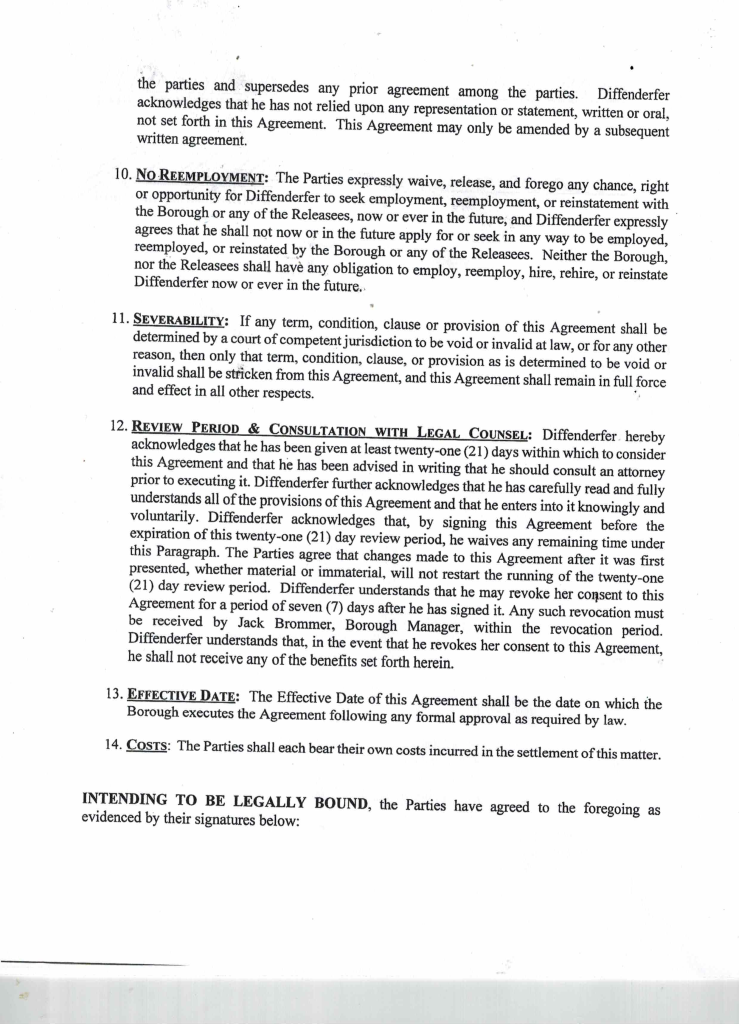
What the agreement says: Section 13 reads: “The Effective Date of this Agreement shall be the date on which the Borough executes the Agreement following any formal approval as required by law.” Section 1 says Diffenderfer’s employment ends “upon her signature,” effective Oct. 26.
What the law says: The agreement gives Diffenderfer 21 days to consider it and seven days to revoke it after signing. Those are the terms federal law requires before a worker 40 or older can waive an age-discrimination claim, and the agreement does release claims under the Age Discrimination in Employment Act. Under that law and the federal rules that carry it out, the seven-day period cannot be shortened, and the agreement “shall not become effective or enforceable until the revocation period has expired.”
Read together, the document ended her employment on a Monday under an agreement that, by its own terms and by the federal rule it borrows, was not yet in effect. The question for council: what was the borough’s authority to treat her as separated on Oct. 26, and on what date does the borough say the agreement took effect?
3. The closed session and the public vote
What the law says: Pennsylvania’s Sunshine Act requires “official action and deliberations” by a quorum of council to happen at a meeting open to the public. Council may discuss certain personnel matters in executive session, but the act says official action on what is discussed there “shall be taken at an open meeting,” and the reason for the session has to be announced at the public meeting just before or after it.
The act also gives residents a remedy. A court may, at its discretion, invalidate official action taken at a meeting that did not meet the law’s requirements. A challenge has to be filed within 30 days of an open meeting, or within 30 days of discovering an action taken at a closed one, and never more than a year later.
Council did vote in public on Nov. 5. The question for council: who decided, and where, that the borough would sign on Oct. 26, three days before the executive session and 10 days before the vote?
4. “Predecisional”
What council has said: On Nov. 5, a member said the agreement could not be released yet because it was “predecisional.” Byers later explained that “the separation benefits still needed approved by council.”
What the law says: The Right-to-Know Law does let an agency withhold records of its “internal, predecisional deliberations.” But the Pennsylvania Supreme Court ruled in 2003, in a case brought by the Tribune-Review against a housing authority, that a public agency’s settlement agreement is a public record even when it contains a confidentiality clause. The state Office of Open Records has also ruled that a settlement agreement is not exempt just because it was given to a quorum for deliberation.
The agreement itself agrees. Section 4 says nothing in it requires the borough “to withhold information that is subject to disclosure under the Pennsylvania Right-to-Know Law.” The question for council: how was a document both sides had signed 10 days earlier still predecisional on Nov. 5?
5. Language written for someone else
The agreement’s opening says Diffenderfer was “a salaried, exempt employee.” She was not in a union. Yet the document:
- Says “Diffenderfer and the Union” release the borough from claims, and that “Diffenderfer and the Union” will withdraw any grievances. No union signed it.
- Releases claims under Act 111. That is the 1968 state law that gives police officers and firefighters the right to bargain collectively.
- Releases claims under the Pennsylvania Labor Relations Act, which the state’s own labor board describes as covering private-sector labor disputes.
- Has her promise she has filed no “unfair labor practices,” and says the deal sets no “past practice.” Both are terms from union contracts.
- Says the borough may still act on matters needing action from “another law enforcement agency.”
- Calls Diffenderfer “he” at least 18 times, and “she” once.
- Ends her insurance on “November 31, 2026,” a date that does not exist.
- Has no Section 3. The numbering goes from 2 to 4.
- Is titled a “Settlement Agreement and General Release” but calls itself a “Separation Agreement” in Section 4.
Taken together, the wording reads like a form prepared for a unionized police or fire employee and reused. The Chronicle could not determine what form the borough started from. Byers has said the agreement was written by the borough’s labor attorney.
Why it matters: Mistakes like these do not cancel a contract; Section 11 says that if a court strikes one part, the rest stands. But under general contract law, unclear terms are usually read against the side that wrote them, and an insurance end date that does not exist is the kind of term people end up arguing over. The question for council: who reviewed this document before the borough signed it, and what did the borough pay to have it prepared?
6. What each side got
What the agreement says: Diffenderfer is paid for unused flex time and leave “consistent with Borough policy,” keeps borough insurance through November, and may buy continued coverage afterward at her own cost. No dollar amount appears anywhere. In return she gives up any claim against the borough, its officials and its employees.
The agreement also says what she receives is “in addition to anything of value to which he is already entitled.” The question for council: if borough policy already provided for paying out unused leave, what did the borough add in exchange for the release, and what was the total cost? Payments of public money are financial records under the Right-to-Know Law.
One more detail: the agreement calls her an “exempt” employee. Federal overtime law does not require compensatory time for exempt employees, so any flex-time payout would have to come from the borough’s own policy. Which policy that is has not been made public.
7. Why have an agreement at all
Pennsylvania is an at-will employment state, and a non-union borough employee without a contract can generally resign or be let go without a signed agreement. What a document like this buys an employer is the release: a promise not to sue.
The agreement lists the laws she can no longer sue under, including the federal civil rights, disability, age and family-leave laws, the Pennsylvania Human Relations Act and the Local Agency Law. It also says, in Section 6, that the borough “in no way” admits it harmed her or treated her unlawfully. The agreement opens by saying it is meant “to resolve any and all grievances,” and it does not say what those were.
8. The investigations clause
What the agreement says: The borough “will conclude any active investigations regarding Diffenderfer” and will take no legal action “on any current or prior investigations,” except for matters that may require investigation or action by another law enforcement agency.
The agreement does not say that any investigation existed, and it describes none. Asked whether one was active on Oct. 26, Byers said: “By state law, we legally cannot comment on things like that.” The Chronicle has no information that Diffenderfer did anything wrong, and nothing in the agreement says she did.
9. Silence, both ways
Diffenderfer agrees to keep the terms confidential “to the extent permitted by law” and never to seek work with the borough again. Each side agrees not to knowingly publish false statements meant to harm the other. Reached by the Chronicle earlier this month, Diffenderfer said she could not speak about it.
Questions for council tonight
- What action of council authorized the borough’s signature on Oct. 26?
- On what date does the borough say the agreement took effect?
- Did council’s Nov. 5 vote approve the whole agreement, or only its costs?
- Why was a signed agreement called “predecisional” on Nov. 5?
- Why does an agreement with a non-union manager name “the Union” and the police and fire bargaining law?
- When does her insurance end, since there is no Nov. 31?
- How much was Diffenderfer paid, and how much did the borough pay its labor attorney for this agreement?
- Was any investigation open on Oct. 26, and how was it concluded?
Byers is the only member of council who has answered the Chronicle’s questions. Kauffman, Mayor Leo Lutz and the other members have not. The Chronicle’s Right-to-Know request for the Nov. 5 motion, any written authorization for the signature and the total cost is pending. The borough’s solicitor and any member of council are welcome to respond, and the Chronicle will publish what they say.
Laws cited: Borough Code, 8 Pa.C.S. § 1006(4); Sunshine Act, 65 Pa.C.S. §§ 704, 708 and 713; Right-to-Know Law, 65 P.S. § 67.708(b)(10); Tribune-Review Publishing Co. v. Westmoreland County Housing Authority (Pa. 2003); Older Workers Benefit Protection Act, 29 U.S.C. § 626(f), and 29 C.F.R. § 1625.22; Act 111 of 1968.